
How Obsolete Tools Quietly Sabotage Your SIGINT Mission
When Your Software Becomes a Threat to the Mission
SIGINT missions rarely fail because of a lack of collection. In SIGINT systems, arrays, receivers, and antennas typically perform as required. Breakdowns more often occur within the SIGINT analysis software that sits between raw RF and finished intelligence. When that signals decoding software is obsolete, inadequately maintained, or designed primarily for casual spectrum viewing rather than professional intelligence work, it can degrade mission effectiveness.
When operators rely on SIGINT tools that cannot decode current targets, the impact is not limited to technical inconvenience. It can lead to missed emitters, incorrect assumptions about the operational environment, and gaps in awareness that can influence decisions at higher command levels. As a developer of professional SIGINT analysis software, we have observed substantial differences between hobby-focused tools and those of mission-driven suites such as Krypto500 and Krypto1000.
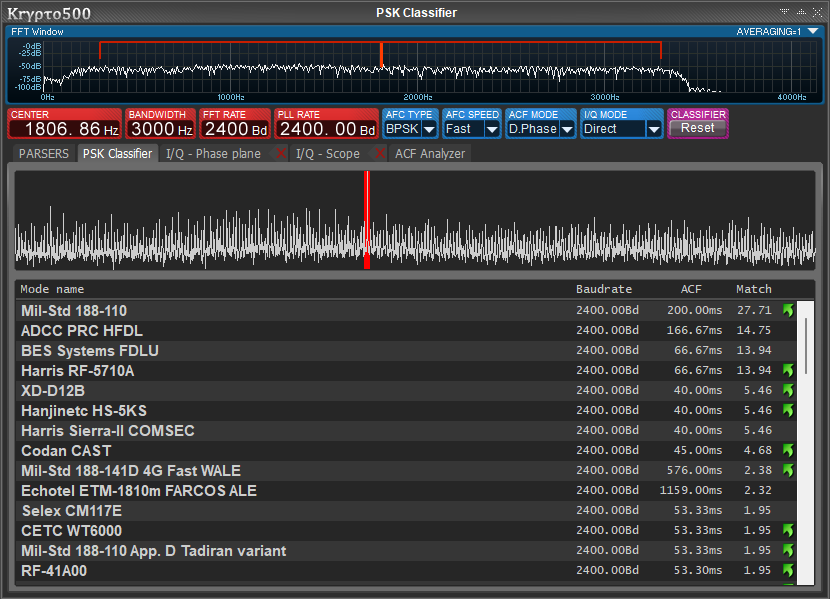
Many organizations still employ products that were not originally designed to support demanding COMINT and EW operations. These tools may be suitable for users who focus on visual RF exploration, but in a professional context they can introduce avoidable risk to mission outcomes. Examples are spectrum monitoring software that contain basic solutions such as a Lora decoder, Bluetooth decoder, AIS decoder, DMR decoder, GPS decoder, DPS decoder, Pager decoder, GNSS decoder, Packet decoder, DVB decoder or DCS decoder. All work well for the basic open standard, but do not contain solutions to proprietary variations, nor adequate parsers needed to extract intelligence. While some may be described as real-time signals analysis software, they cannot be described as protocol decoder software or much less, as SIGINT software without these additional, vital tools.
The Hidden Risks of Hobby and "Spectrum Awareness" Tools
Hobby and spectrum awareness tools often share a design philosophy: make RF visible and engaging. Waterfalls, spectrograms, and colorful displays are frequently prioritized, because the primary users want to observe activity across a band and explore it manually. That approach can be informative, but it is not equivalent to producing reliable, actionable intelligence.
These products are usually not derived from a threat- or target-driven requirement set. Instead of asking, "What current adversary systems must we decode?" they often ask, "What is interesting to explore?" This can result in significant gaps where operationally relevant targets should be covered.
Typical technical shortcomings include:
Missing or incomplete support for current target communications waveforms
Decoders that are absent or that perform reliably only under ideal laboratory conditions
Limited protocol support that stops at basic framing or headers
Parsers that cannot consistently extract metadata and technical parameters
Infrequent or ad hoc updates that are not driven by changes in adversary activity
When these weaknesses are present in an operational context, they create risk. Signals of interest may be misidentified or not detected at all. Emitters that should contribute to an electronic order of battle in an Electronic Warfare (EW) software suite may be omitted. Reporting generated from such tools can create an illusion of coverage, in which operators believe they understand most of the environment while remaining unaware of many signals that are operationally significant.
Relying on software that is obsolete, inadequately maintained, or originally designed for hobby or basic spectrum awareness use is not just a technical choice. It is an acceptance of avoidable operational risk for every mission that depends on that software.
Detectors vs Decoders: Why Waveform Coverage Matters
There is an important distinction between detecting RF energy and decoding intelligence. Many hobby-focused products provide competent detectors. They can indicate that a transmission exists at a given frequency and may estimate a modulation type or bandwidth. For recreational use, this may be sufficient. For signals intelligence (SIGINT) work, it is not.
Actionable communications intelligence (COMINT) requires access to content (where appropriate and lawful), metadata, and protocol behavior, not just confirmation that a signal is present. If SIGINT analysis software stops at energy detection or basic classification, operators are left observing waterfalls while the critical information within the traffic remains inaccessible.
A professional SIGINT analysis suite must:
Reliably detect the signal type and waveform
Decode content where appropriate and lawful
Extract technical parameters relevant to ESM (electronic support measures) and EW
Parse higher-layer protocols to reveal structure, behavior, and intent
Support agile, adaptive, and modern digital signals that change over time and do not remain static
Broad and current waveform coverage, backed by robust decoders and parsers, is what converts RF energy into signals intelligence. Detectors alone can create a false sense of understanding: the system confirms the presence of activity, but does not reveal its nature, purpose, or implications.Detectors that do not and cannot precisely classify and identify the exact target modem in use are misleading.
The Cost of Obsolete and Irrelevant Decoders
Many spectrum monitoring software tools promote long decoder lists as evidence of capability. However, a substantial portion of those digital signal decoders may target signals that are no longer in operational use. Having numerous decoders for legacy or long-retired modes does not significantly contribute to deriving intelligence on contemporary adversaries.
This misalignment creates several types of cost:
Opportunity cost: operators may spend time examining emissions that are irrelevant to current mission objectives
Misallocated effort: search patterns can be shaped by what the software can decode, rather than by the actual target set
Analytical clutter: reporting and databases may fill with information on non-target or obsolete signals
Over time, this distorts understanding of the RF environment. Current threat systems that are not represented in the digital signals decoder set can remain unobserved. Indicators and warnings that depend on those systems may be delayed or absent. The electronic order of battle that should inform planning and operations may then be based on partial or biased data.
At higher decision levels, this is not a minor technical issue. It introduces the risk that critical warning signs are overlooked, that adversary activities are under-reported, and that decision-makers operate with an incomplete picture of the spectrum.

Closing the Decoder Gap with Krypto500 and Krypto1000
We developed Krypto500 and Krypto1000 specifically for government, military, and intelligence organizations that require professional-grade SIGINT analysis. Krypto500 focuses on ELF through HF, while Krypto1000 covers VHF through SHF and satellite targets. Both SIGINT software suites are designed for COMINT, EW, and SIGINT missions in demanding operational environments.
Unlike hobby-oriented tools, these digital signals decoder suites are driven by mission and threat requirements rather than by visual presentation features. They provide extensive coverage of current decoders, including modern, rare, and nation-specific waveforms and parsers that correspond to real-world target sets.
Key characteristics include:
Emphasis on present and emerging modes rather than primarily legacy or retired systems
Deep parser support to extract technical, protocol-level, and behavioral details
Integration of analysis, decoding, and COMINT-relevant parameters in a single environment
Continuous updates driven by changes in adversary systems and operational needs
Because they are mission-driven and continuously updated, Krypto500 and Krypto1000 are intended to evolve as signals change, reducing the risk that operators focus on outdated targets while new waveforms go unrecognized.
Upgrading From Risk to Reliability in Your SIGINT Stack
To assess whether current SIGINT analysis software supports or degrades mission performance, organizations should conduct a structured audit. This includes examining how the product is positioned and what capabilities the vendor emphasizes. Heavy focus on hobby usage, generic spectrum awareness, or extensive lists of primarily legacy decoders should prompt closer scrutiny.
Practical steps include:
Compare the operational target list to the waveform and protocol coverage the tools actually provide
Identify where decoders are absent or focus predominantly on obsolete signals
Review how frequently the software is updated and what drives those updates
Evaluate how effectively the tools decode content (where lawful), extract parameters, and parse higher-layer data, not just detect energy
Then map those findings against operational requirements. Determine whether the current real-time signals analysis software stack supports the systems and bands that matter most. Any identified gaps correspond to emitters that may not be observed, traffic that is not decoded, and decisions made with incomplete information.
From the perspective of COMINT Consulting, the core message is clear: digital signals decoder and parser coverage that is aligned with current and emerging targets is essential. Suites such as Krypto500 for ELF through HF and Krypto1000 for VHF through SHF and satellite are designed to address this requirement by providing extensive, mission-focused decoder coverage and continuous updates. In modern SIGINT solutions, the quality and relevance of analysis software are directly connected to mission reliability.
Enhance Your Intelligence Workflow With Proven SIGINT Tools
If you are ready to modernize your signals operations, our SIGINT analysis software gives your team the power to work faster and with greater confidence. At COMINT Consulting, we design our solutions to fit into real-world mission environments so you can focus on insights instead of tools. Tell us about your requirements and we will help you define a practical path forward. To start a conversation with our engineers and analysts, simply contact us.


Comments