
The Scary Reality of Missed SIGINT and COMINT Signals
The Reality of Missed SIGINT and COMINT Signals
A signal does not need to be hidden, encrypted, or rare to be missed. It may be present in the collection, yet remain unreadable because the available COMINT software cannot recognize, process, or decode its mode.
That is more than a technical inconvenience. When you cannot turn RF activity into usable information, you can lose timely awareness of communications activity, shifting patterns, or transmissions that deserve closer review.

Krypto500 processing a variant Mil-Std 188-110A serail modem
See the Risks Before Signals Become Blind Spots
Across SIGINT, COMINT, electronic warfare, and radio-monitoring work, detection is only the beginning. A receiver may show energy on a frequency, but that does not tell you who is communicating, what mode is in use, what the content means, or whether the transmission matters to your mission.
Modern targets can include far more than the familiar signals seen during routine monitoring. We may encounter analog traffic, digital transmissions, short bursts, spread-spectrum activity, satellite communications, data links, and proprietary formats. If your organization uses other software for its COMINT or SIGINT effort, there may be targets you cannot decode.
Without the correct decoder, a captured signal can become a blind spot across the monitored spectrum, from ELF through SHF. Analysts may be unable to:
Identify the transmission mode with confidence
Recover available content or technical details
Classify the signal for later correlation
Determine whether activity is routine, unusual, or operationally significant
For that reason, we recommend reviewing decoder coverage before an important signal appears, not after it has gone unanswered. Our supported modes resource is a practical place to examine coverage in detail rather than assuming a familiar tool can handle every target.
COMINT Software Determines What You Can See
COMINT software shapes the full analysis process. It affects signal identification, demodulation, decoding, classification, logging, and reporting. The software layer decides whether captured RF activity becomes information your team can assess and act on.
A limited decoder library may perform well for a narrow set of known targets. Trouble begins when a signal changes frequency, modulation, bandwidth, data rate, or transmission method. What looked like solid coverage during a routine task can fall short during a broader collection effort.
Preparedness means being ready to examine both known and unfamiliar emissions without repeatedly reaching a technical dead end. We designed Krypto500 and Krypto1000 for professional signal analysis and decoding across broad frequency ranges and varied mission environments. That broad approach matters when your work does not stay neatly inside a small list of expected modes.
The question is not simply whether your platform can find a signal. The real question is whether it can help you understand it. A detected but undecoded transmission may leave you with a waterfall display, a recording, and unanswered questions.

Krypto500 RF-41A00 decoding a File Transfer
Coverage Gaps Grow When Operators Need Speed
Time pressure changes everything. During SIGINT, COMINT, electronic warfare, or radio-monitoring operations, analysts may not have the option to wait for a future decoder, a software update, or outside technical support. A brief transmission may not repeat on demand.
When coverage is incomplete, manual investigation can consume time that should be spent assessing the activity itself. Teams may compare waveforms, export recordings, test workarounds, or search for technical clues one piece at a time. That work can be useful, but it should not be the only path forward for signals your mission needs to understand.
Incomplete decoding also raises the chance of a poor assessment. An unfamiliar transmission may be dismissed as noise, routine traffic, encrypted content, or irrelevant activity simply because the available software cannot decode it properly.
Dependable COMINT software should help your team investigate quickly while preserving technical detail for later review, correlation, and reporting. Speed matters, but so does retaining the information needed to revisit a signal when new context appears.
Fall Readiness Demands Proven Mode Coverage
Fall often brings renewed training cycles, field exercises, operational evaluations, procurement planning, and year-end capability reviews. It is a sensible time to examine whether your decoding environment matches the targets your team may actually encounter.
We encourage you to compare your current COMINT software against your mission requirements, not only against the signals you decoded in the past. Review the frequency ranges, target types, and communication modes that matter most to your collection work.
Useful questions include:
Which modes can your team decode today?
Which targets require manual workarounds?
Which recordings remain unresolved after collection?
Which known or emerging signal types fall outside your current decoder library?
Can your software retain useful details for reporting and later analysis?
A capability review should focus on demonstrated mode coverage and professional analysis functions. As target environments expand or change, your tools must be ready for more than yesterday’s familiar traffic.
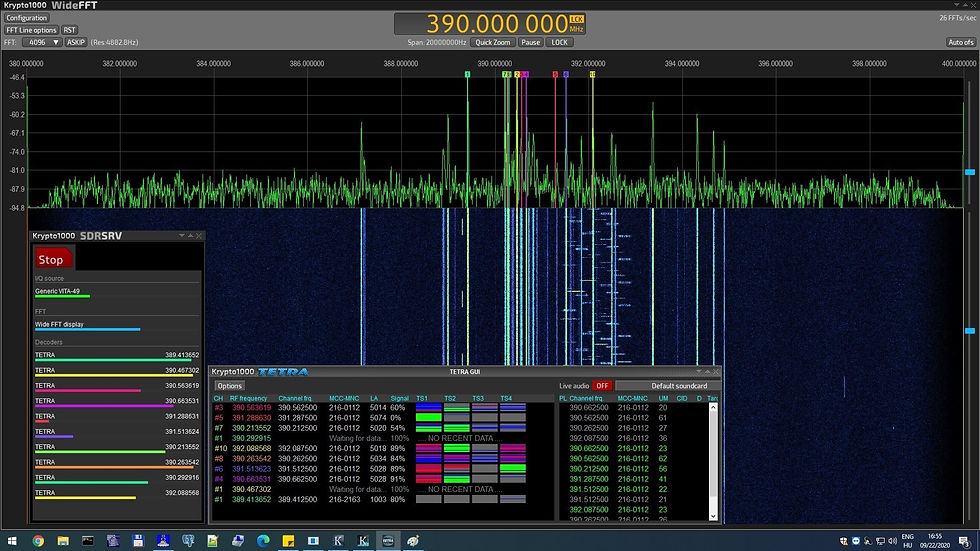
Krypto1000 processing numerous TETRA channels
Audit Your Decode Coverage Before Critical Signals Go Quiet
Missed signals are not always caused by weak collection. In many cases, the signal was captured, but insufficient decoding capability prevented analysts from extracting meaning after the fact. That gap can leave you without the insight needed to understand communications activity or changing behavior.
Before the next high-priority requirement arrives, decoding coverage should be assessed against the full range of targets a mission may encounter. Mission readiness depends on the ability to identify, decode, preserve, and interpret relevant signals. The best time to find a decoding gap is before the signal you need has gone quiet.
Strengthen Your Decoding Capability
COMINT Consulting can help you evaluate whether your current tools support reliable signal identification, decoding, and analysis across evolving requirements. Review our COMINT software to see how Krypto1000 can support broader decoding coverage and operational workflows. For a focused discussion of your requirements, contact us to speak with our team.


Comments