Wideband Multichannel Signal Interception with Krypto
Turn Wideband Spectrum Into Actionable Intelligence
Wideband collection helps authorized COMINT and SIGINT teams maintain awareness when the RF environment is crowded, active, and subject to rapid change. Across ELF through SHF, including VHF, UHF, and satellite-related communications, operators may need to observe multiple signals, short bursts, and parallel networks within the same spectrum segment.
A single narrowband receiver can force difficult choices. While an operator is tuned to one target, other signals may appear, move, or disappear elsewhere in the available band. Our Krypto1000 and Krypto500 suites provide a software-based approach to signals interception software that supports simultaneous analysis, classification, demodulation, decoding, and network intelligence from a wider collection source.
With the appropriate authorized mission and connected hardware, Krypto1000 can control a wideband tuner as a front-end receiver. This allows teams to stare at a very broad portion of the available spectrum, or the entire available spectrum where receiver and operational conditions permit, instead of repeatedly retuning between individual targets.
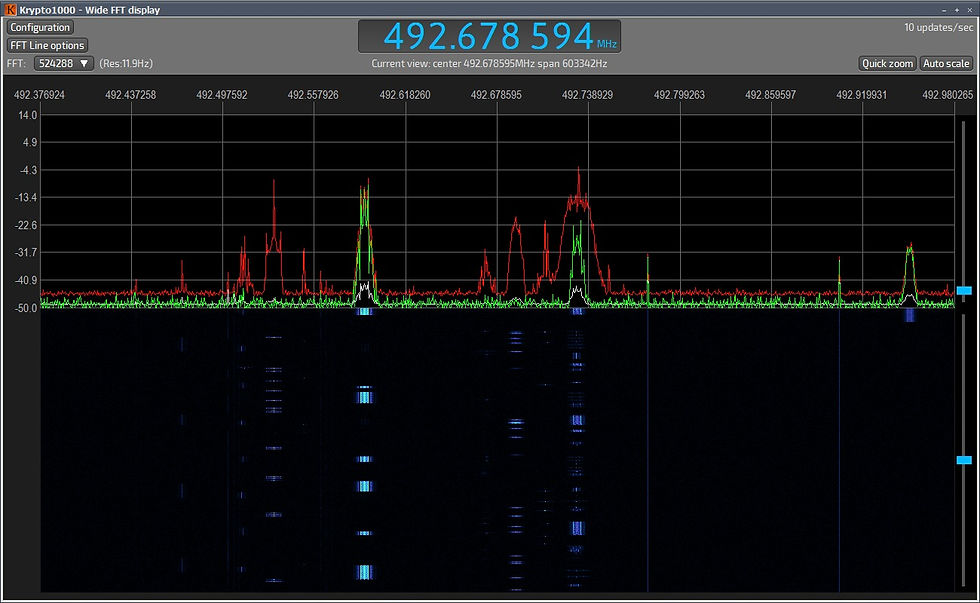
Krypto1000 in action
Use a Wideband Tuner to Stare Across the Spectrum
Krypto1000 works with a wideband tuner or SDR front end to collect a large spectrum span. Rather than assigning a separate receiver to every signal of interest, you can bring a broad RF view into a central collection point and select channels for examination as activity develops.
That broader view supports a more complete understanding of what is present in the RF environment. It can help your team identify active channels, locate target modems, observe changes in transmission behavior, and decide which signals require deeper technical processing.
The practical coverage available to you depends on the connected equipment and mission conditions, including:
Receiver and SDR frequency range and bandwidth
Antenna system performance
IQ storage and transport capacity
Available processing resources
Authorized collection requirements
Visibility across VHF, UHF, SHF, and satellite-related environments does not remove operational limits. Instead, it gives your team a way to work within those limits more efficiently. A broad collection source can reduce the need to interrupt monitoring simply because another signal has become active nearby.
Stream IQ Channels to Distributed Analyst Workstations
Collection and analysis do not need to occur at the same workstation. Krypto1000 can stream IQ channels from a wideband collection source to workstations equipped with Krypto500 and Krypto1000. This creates a multichannel environment in which selected signals can be examined by different personnel at the same time.
For example, one central receiver can provide selected IQ channels to technical operators performing modem analysis, analysts reviewing traffic and network behavior, and linguists working with available decoded material. Each function can proceed in parallel without requiring every user to control the wideband front end directly.
This separation supports a clearer workflow:
Centralized collection from the connected wideband tuner or SDR
Distribution of selected IQ channels to qualified workstations
Parallel review of different target signals
Faster triage when new activity appears
Less dependence on one analyst handling every task
Actual throughput remains dependent on network capacity, SDR connectivity, workstation performance, storage, and the available operational team. Even so, distributing work can help prevent a busy RF environment from becoming a single-operator bottleneck.

Krypto500 and Krypto1000 accept numerous streaming or offline inputs
Process Multiple Target Modems in Parallel
Once IQ channels are available to the processing environment, Krypto500 and Krypto1000 support the core work expected in COMINT and SIGINT operations. Our suites support digital signal analysis, modem classification, digital signal demodulation, decoding, parsing, traffic analysis, nodal analysis, automatic network diagramming, and radio fingerprinting.
The combined Krypto environment can process multiple ELF-SHF target modems simultaneously when the underlying receiver connection, hardware, network infrastructure, and qualified personnel support that workload. The software does not turn every signal into an immediate answer. It gives operators and analysts a structured path from signal discovery to technical understanding.
A team may begin by identifying an unknown transmission and determining modem characteristics. From there, available content or metadata can be decoded and parsed, traffic relationships can be reviewed, and network links can be mapped. Radio fingerprinting can also assist with recognizing recurring transmitters or devices when appropriate to the authorized mission.
Parallel processing matters because simultaneous targets often require different forms of attention. One signal may need classification, another may need decoding, and another may reveal useful network behavior. Handling those tasks across separate workstations can keep the wider collection picture in view while deeper analysis continues.
Expand Signals Interception Software Without Artificial Limits
Krypto1000 does not impose fixed software bandwidth or channel-number limits. The usable limits come from the hardware around it, including the tuner or SDR, the connection to the SDR, IQ transport capacity, processing resources, and the capacity of COMINT and SIGINT operators, analysts, and linguists.
This architecture can provide significant additional capability without requiring a separate narrowband collection and decoding system for every signal. A wideband source can feed selected IQ channels into the Krypto environment, allowing your team to direct available resources toward the signals that matter most.
Scalability is also useful for planning. You can begin with the receiver, SDR, and workstation resources already available, then add collection hardware, processing workstations, network capacity, or analyst support as requirements grow. September is a practical time to assess year-end equipment priorities and prepare for future collection needs.
The goal is not simply to collect more spectrum. It is to create a system in which collection capacity, analysis capacity, and personnel workflows are aligned. When those elements are planned together, wideband monitoring can remain manageable even as target activity increases.

Krypto1000 decoding multiple channels of TETRA
Build a Multichannel Krypto Capability for Future Missions
Before designing a multichannel deployment, we recommend assessing the elements that define practical performance: receiver bandwidth, SDR connectivity, antenna coverage, IQ distribution capacity, workstation processing capability, storage, and analyst workflows. These factors determine how much of the spectrum can be observed and how many targets can be handled at one time.
Our free Multichannel SIGINT application note is available on the Resources page under Application Notes. It provides a more detailed overview of the Krypto multichannel approach and the relationship between wideband collection, IQ streaming, and distributed processing.
A useful deployment plan begins with the mission, then matches collection and analysis resources to the types of signals your authorized team expects to encounter. By accounting for hardware limits, network capacity, and personnel roles early, you can build a multichannel capability that remains clear, scalable, and focused on actionable intelligence.
Strengthen Your Signal Collection Capability
COMINT Consulting can help your authorized team evaluate signals interception software for demanding multichannel collection requirements. We provide technical guidance aligned with operational objectives, infrastructure constraints, and analyst workflows. To discuss your requirements with our team, contact us.


Comments