
COMINT Demodulation: Prioritize Settings for Low SNR, Doppler, and Bursts
Turning Degraded COMINT Signals Into Actionable Intelligence
Digital signal demodulation in a controlled laboratory environment is straightforward. Signal demodulation in a hot, jammed, late-summer exercise is not. In the field, operators face low SNR, high platform velocities, irregular bursts, and channels that do not match any predefined plan. That is where tactical COMINT software must be effective every day.
The objective is not only to detect that a signal is present. The objective is to extract bit streams, protocols, and meaning from signals that are short, weak, or heavily distorted. When useful intelligence is derived from these partial signals, commanders gain earlier warning, observable patterns, and additional courses of action. When those signals are missed by your SIGINT tools, threats remain concealed.
Signal demodulation software operates at this critical boundary. The algorithms selected, the parameter sets standardized, and the validation performed prior to deployment can determine whether intercepts are decoded reliably or lost. At COMINT Consulting, we develop suites such as Krypto500 and Krypto1000 SIGINT software to remain effective when the RF environment is highly contested and non-cooperative.
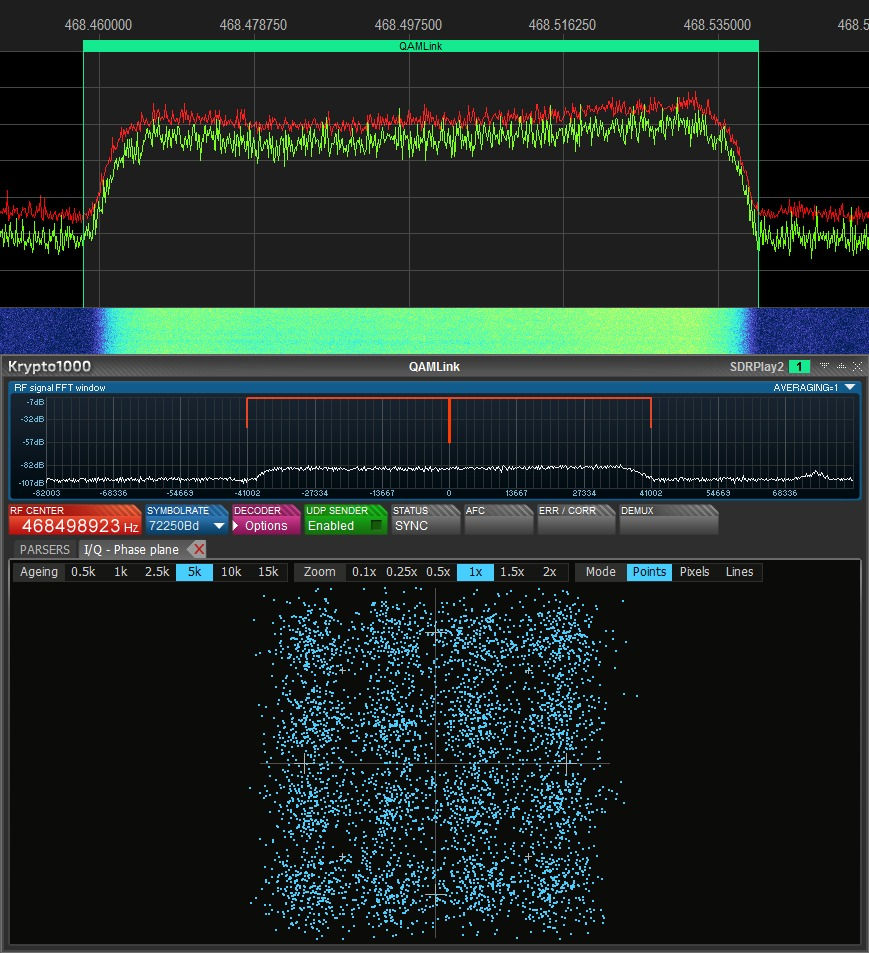
Krypto1000 synchronized and demodulatting/decoding a weak 16QAM (QAM-16) signal
Understanding the Realities of Contested Tactical Channels
Contested tactical channels present an adversarial environment. In many operations, especially in late summer when temperature, weather, and heavy training activity interact, RF conditions can degrade rapidly. Typical effects include:
Very low SNR from long ranges or small, low-power emitters
Multipath and fading caused by terrain, buildings, and sea states
Doppler shifts from aircraft, UAVs, ships, and rapidly moving ground units
Rapid frequency hopping and time-varying channels
Dense co-channel interference in crowded bands
Many legacy digital signal demodulators assume comparatively benign conditions. They expect a stable carrier, long dwell times, and a slowly varying channel. They favor predictable symbol timing, long training sequences, and extended convergence times. In a contested theater, those assumptions are rarely valid.
Threat waveforms are also evolving. There is increased use of:
Higher-order modulations to support higher data rates
Adaptive coding that varies with channel quality
Short, duty-cycled bursts instead of long continuous carriers
Low probability of intercept (LPI) and low probability of detection (LPD) techniques to mask activity in noise or clutter
Non-standard channelization that does not align with fixed grid plans
Demodulation routines that rely on near-ideal conditions will fail to exploit a significant fraction of operationally relevant signals.
Demodulation Priorities When SNR Is Marginal
When SNR is marginal, maintaining a reliable lock on the desired signal is the primary requirement. Signal demodulation software must preserve the waveform while resisting corruption by noise. This requires algorithms and operating modes that remain effective at very low SNR.
Key priorities include:
Coherent demodulation when phase can be tracked, supported by robust carrier and timing loops
Noncoherent or differential modes when phase cannot be trusted
Soft-decision metrics provided to subsequent decoding stages, rather than only hard symbol decisions
Synchronization routines designed to operate with weak pilots and short preambles
Practical parameter choices are as important as theoretical design. On deployed systems, focus areas include:
Bandwidth optimization: wide enough to contain the signal, but narrow enough to reduce noise
Matched filters aligned to expected pulse shapes
Integration times that balance responsiveness and reliability, particularly for bursty signals
Efficient symbol rate searches that avoid expending time on infeasible values
Clear policies for when to rely on automatic parameter search versus operator-driven control
Noise and interference are persistent factors, so suppression must be selective rather than overly aggressive. Effective methods include:
Channel estimation that tracks fading rather than assuming flat gain
Whitening and de-correlation of noise prior to timing recovery and equalization
Adaptive notch filters targeted at strong interferers without degrading the desired signal
Interference cancellation approaches that preserve very low-level targets
The objective is to maintain sufficient signal integrity for decoding, even when the signal is only slightly above the noise floor.
Managing Doppler, Mobility, and Rapidly Drifting Carriers
Platform motion significantly affects carrier stability. Airborne ISR, maritime patrol, and fast armored platforms all introduce substantial Doppler and time-varying frequency offsets. Under the hot summer atmospheric conditions, with temperature gradients and turbulence, RF paths can vary further.
To maintain lock, signal demodulation software should provide:
Wide Doppler search windows during acquisition
High-resolution carrier tracking loops once locked
Time-varying frequency estimators that anticipate drift rather than assuming static tones
Pilot-aided tracking when known patterns exist, and blind techniques when they do not
There is an inherent tradeoff between responsiveness and stability. Loops that are too slow will not track rapid changes; loops that are too fast risk tracking noise or nearby emitters instead of the desired signal.
Key design considerations include:
Distinct acquisition and tracking modes with appropriately chosen loop bandwidths
Lock detectors that avoid jumping to strong but incorrect carriers
Constraints on allowable frequency change per unit time, consistent with realistic platform motion
In congested bands, false locks are a significant risk. Robust designs use multiple validation metrics, not just power peaks, before confirming a carrier lock.
Addressing Short Bursts, Duty-Cycled Signals, and Uncertain Channels
Short bursts and duty-cycled signals invalidate many of the assumptions used in traditional designs. The demodulator lacks time for extended averaging, fine-grained equalization, or slow training. In such cases, legacy demodulation routines may not converge before the signal ends.
To address these conditions, demodulation software should support:
Rapid acquisition engines that can establish timing and frequency in very few symbols
Preamble and marker detectors tuned to known emitter families
Timing recovery methods that operate with minimal training and noisy transitions
Buffers and processing pipelines optimized for very short frames rather than only for continuous streams
Uncertain channelization introduces additional complexity. The exact sub-channel position, bandwidth, and packing relative to neighbors may be unknown. Suitable capabilities include:
Wideband signals analysis and capture followed by adaptive sub-channelization
Flexible channel banks instead of fixed, rigid grids
Blind signal classification to infer modulation type, symbol rate, and basic structure
Automated isolation and demodulation of intermittent or elusive emitters
Purpose-built COMINT tools enable repeatable workflows for handling such signals across missions and teams.

Krypto500 synchronized and demodulating/decoding a 16QAM (QAM-16) signal
Validating Demodulation Settings Before High-Intensity Operations
Parameter sets that perform well in design documents must be validated under realistic conditions before high-intensity operations. A disciplined workflow enables teams to move from theory to trusted field profiles.
A representative validation loop includes:
Laboratory tests with synthetic channels: controlled SNR, Doppler, fading, and interference
Hardware-in-the-loop trials: actual radios, antennas, and recorders
Progressive field work during summer training events and joint exercises
In each phase, relevant metrics include:
Acquisition time for initial lock
Bit error rate and frame error rate across representative conditions
Classification accuracy for modulation and waveform type
Demodulation success rate per intercept, particularly for short bursts
Repeatability and traceability are critical. This implies:
Logging demodulation outcomes together with full parameter sets and RF conditions
Using recorded I/Q data from real missions as regression test inputs
Maintaining shared parameter templates so that effective configurations are available to all teams
Suites such as Krypto500 and Krypto1000 COMINT/SIGINT software are designed to support this workflow, providing a common environment for operators and engineers to refine, compare, and standardize demodulation settings aligned with contested operational realities.
Translating Demodulation Performance Into Tactical Advantage
When demodulation chains are properly tuned and validated, operational benefits appear quickly. Units receive earlier threat warning because weak emitters are decoded rather than discarded. Analysts obtain cleaner bit streams, more reliable emitter characterizations, and fewer gaps in event timelines. Commanders receive more complete information to support decision-making.
To achieve this, organizations should:
Prioritize low-SNR performance in demodulation design and configuration
Treat Doppler tracking and drift tolerance as baseline requirements
Make burst handling and short-dwell operation mandatory capabilities
Assume uncertain channelization and design for it from the outset
Standardize demodulation parameter profiles by mission set and theater
Integrate objective validation into pre-deployment workups
At COMINT Consulting, our focus is supporting COMINT and SIGINT teams with tools engineered for contested tactical channels from the start. When operators, engineers, and analysts share a common, validated signal demodulation software toolkit, they are better prepared to convert degraded signals into timely, actionable intelligence in demanding RF environments.
Power Your Signals Intelligence With Proven Performance
If you are ready to capture more intelligence from every intercept, our signal demodulation software is built to keep pace with your mission. At COMINT Consulting, we design tools that help teams move from raw signals to actionable insight quickly and reliably. Tell us about your operational needs and we will help you configure the right setup. For specialized requirements or pricing details, contact us to speak with our team.


Comments