
Misleading SIGINT Software Claims and Their Hidden Dangers
Updated: Sep 9
Why “Almost Good Enough” SIGINT Tools Are Dangerous
SIGINT software is either trustworthy or it is not. There is no safe middle ground when people, platforms, and missions rely on correct intercept, classification, and decode. If your tools are only catching part of what is on the air, you are not getting a degraded picture, you are getting a distorted one, and that can be far worse than hearing nothing at all.
We see this problem often: vendors presenting long, impressive decoder lists that look competitive with professional suites like Krypto500 and Krypto1000. On paper, it appears you are covered across a wide range of signals, but the reality behind those lists can be dangerously thin. In this article, we will explain how those lists can mislead, where technical blind spots appear, how something as specific as CCIR493-4 exposes the gaps, and what to check before any SIGINT software is fielded.
How Decoder Lists Mislead Analysts and Decision-Makers
Many SIGINT software vendors know that a long decoder list looks persuasive to a busy evaluator. A spreadsheet or brochure full of protocol names gives an immediate sense of breadth. The problem is that length and capability are not the same thing.
One common tactic is inflating lists by repeating the same signal under slightly different names. You might see variants like:
Maritime HF calling protocol
HF calling system, ITU standard
International HF DSC
In reality, all three may map to a single, limited implementation. It feels like you are getting three decoders. Operationally, you are really getting one decoder wearing three different labels.
Another tactic is listing only the standard version of a protocol and implying that this equals complete coverage. For example:
CCIR493-4 HF calling
CCIR493-4 standard
That sounds fine if every manufacturer implemented only the international standard. But signal reality is not that clean. Multiple proprietary and national variants exist on the air, and they often differ in ways that matter directly to decoding. When a vendor lists “CCIR493-4” once and stops there, many evaluators assume parity with professional-grade suites. Even experienced analysts can be misled, because the list looks familiar and the naming appears correct.
In high-density, contested RF environments, that assumption is dangerous. Thinking you have equivalent coverage when you do not means you are blind to traffic you never knew you missed.
The CCIR493-4 Trap: When “One Decoder” Hides a Dozen Blind Spots
CCIR493-4 is a good case study in how this plays out. On paper, it is an international standard for HF calling systems. In practice, there is the standard specification and then there are the many divergent implementations in actual radios produced by different manufacturers.
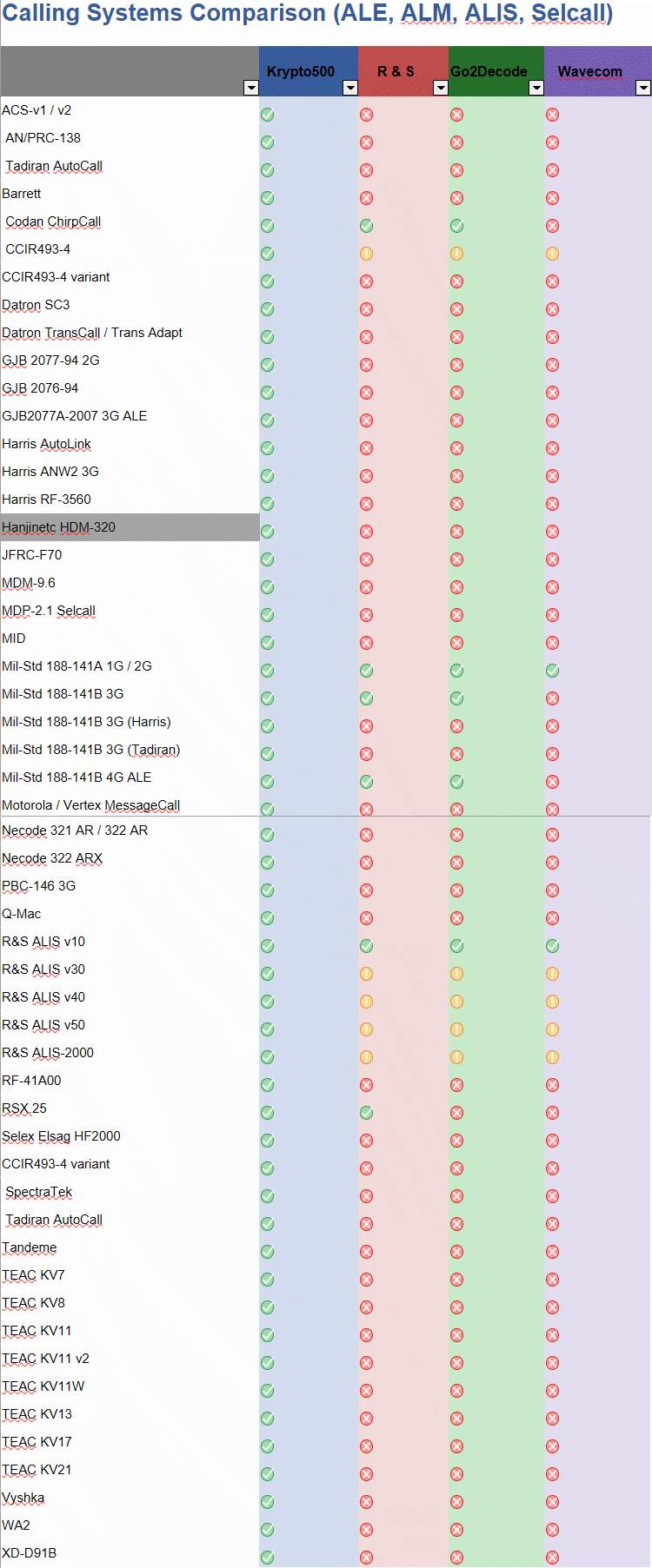
Vendors that list a single “CCIR493-4 decoder” are usually covering only the basic, standard description. That is enough if everyone on the air used only that pure standard. But they do not. Manufacturers such as Barrett, Datron, Vertex Standard, and others implement their own variants. These can differ in framing, timing, specific field usage, or other technical details that matter when you are trying to decode traffic correctly and reliably.
The operational impact is not abstract:
With a single standard-only implementation, operators think they have one strong decoder.
In reality, they are blind to more than ten distinct, real-world variants that do not match that narrow interpretation.
Calls go unrecognized or are misclassified, and there is no clear indication that anything was missed.
Krypto500 was built to address exactly this kind of problem. Its approach to CCIR493-4 is not “one entry on a list,” but automatic detection and decoding of the various manufacturer-specific variants. That means:
The software distinguishes between implementations used by Barrett, Datron, Vertex Standard, and others.
Operators do not have to guess which variant they are seeing or manually switch modes.
Transmissions that deviate from the simple standard are not silently discarded as noise.
Instead of a single name that hides a dozen blind spots, you get actual coverage of what is on the air.

Real Consequences of Being Blind in the Spectrum
Incomplete or shallow decoder coverage does not just show up as a few missing lines in a log. It shows up as an operational risk. In fast-moving military or intelligence operations, those gaps can have direct consequences.
When SIGINT software misses variants or misclassifies traffic, you can see problems such as:
Missed calls that never appear on any operator display
Channels that appear quiet, even though they are active with non-standard implementations
Incorrect signal labeling that misleads analysts about who is talking, where, and about what
These technical failures roll up into mission-level problems. Lost situational awareness means your forces do not see all the players on the field. Gaps in early warning reduce reaction time. The inability to correlate traffic across systems and regions can hide coordination between platforms that should be obvious.
In that context, SIGINT software that leaves entire families of variants unrecognized is not a “partial solution.” On a battlefield, being blind to whole categories of emitters can be just as bad as having no SIGINT capability at all. Believing you are covered when you are not can drive decisions that put personnel and assets in harm’s way.
Red Flags to Spot Misleading SIGINT Software Claims
The good news is that there are practical ways to spot SIGINT software that looks stronger on paper than it is on the air. When you review decoder lists and marketing claims, pay close attention to warning signs like these:
Many near-duplicate decoder names that sound different but may map to the same protocol
Vague protocol descriptions, such as “HF digital modem” without specifying exact standards or variants
No mention of manufacturer-specific or national variants for well-known families like CCIR493-4
Marketing material that stresses the sheer number of decoders as the primary selling point
There are also technical red flags that should prompt deeper questions:
No automatic detection of variants within a protocol family
No clear version history or visible update cadence for decoder modules
Lack of traceable documentation or evidence that decoders were validated against real on-air signals instead of only against lab samples
When you evaluate vendors, it helps to structure your checks:
Insist on live or recorded demonstrations that include known variant families, not just textbook standard signals.
Ask exactly which manufacturers and variants are supported for key protocols, including CCIR493-4.
Compare claimed coverage against an authoritative decoder list, such as the current Krypto500 and Krypto1000 decoder list maintained by us at COMINT Consulting.
These steps quickly separate marketing inflation from genuine SIGINT capability.
Building a SIGINT Posture You Can Trust
Reliable SIGINT software is not an optional improvement, it is foundational to any credible SIGINT or COMINT posture. When your mission depends on intercept and decode, due diligence is not a paperwork exercise. It is part of force protection.
A structured evaluation approach helps ensure that trust is warranted, not assumed:
Verify that claimed decoders actually match your current and expected operational needs.
Test how the software handles variants from multiple manufacturers in realistic RF conditions, not just clean lab signals.
Prioritize depth of implementation and proven variant coverage over the raw count of names on a decoder list.
If you treat every decoder entry as a promise that something on the air will be seen, classified, and decoded correctly, the gaps become easier to spot. The goal is simple: no hidden blind spots, no silent failures, and no false sense of security when operations begin.
Accelerate Your Signal Intelligence Results Today
If you are ready to turn complex signals into clear, actionable intelligence, our SIGINT software is built to help you move faster and with greater accuracy. At COMINT Consulting, we work closely with you to align our solutions with your operational and analytical needs. Tell us about your mission requirements and we will help you define the right approach, from evaluation through deployment. To discuss your project and next steps, simply contact us.


Comments