
The Definitive Guide to Decoder Coverage in Modern SIGINT
Updated: Jul 23
Decoder coverage determines whether modern RF spectrum is actually understood or merely recorded. If a SIGINT or COMINT team cannot decode a signal, the quality of the antenna system or receiver chain is irrelevant. Decoder breadth and depth determine what can be interpreted and exploited across HF, VHF, UHF, and satellite bands.
This article explains why decoder coverage is now a primary indicator of SIGINT capability, how HF decoder software supports long-range intercept, and how complete coverage, performance, validation, and workflow integration should be assessed when evaluating existing systems.
Why Decoder Coverage Defines SIGINT Capability
Every intercepted signal reflects technical choices by the emitter: frequency band, modulation, protocol, framing, encryption, and operating patterns. Decoder coverage is the set of those technical choices that can be reversed. If the software does not implement a given protocol, that communication is effectively noise, even if the recording is technically perfect.
For professional and military users, this constraint shapes system design and procurement. Decoder suites for government, defense, and commercial SIGINT teams must support operational environments in which missing an entire signal family is not acceptable.
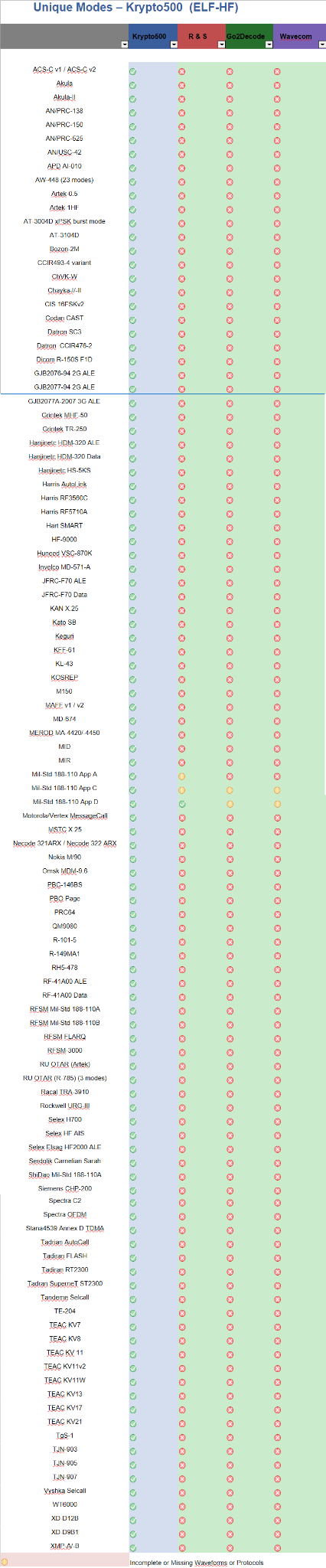
A key measurable parameter is the number and variety of implemented decoders. For example, suites that provide several hundred more decoders for HF, VHF, UHF, and satellite signals than alternative software directly influence:
The number of emitter communities that can be covered
The speed and reliability of signal recognition and classification
The resilience of operations when targets change waveforms or bands
Decoder count is not merely a checklist item. It is a practical way to describe how much of the real-world RF environment can be translated into usable information.
Decoder Types Across HF, VHF, UHF, and Satellite
In professional SIGINT, a decoder is not just a demodulator. It is a complete chain including demodulation, synchronization, framing, error handling, symbol interpretation, and often higher-layer analysis. It is the technical path from raw RF energy to intelligible content.
Decoders can be grouped in families that match operational problem sets:
Legacy narrowband HF services and classic military or governmental modes
Modern digital HF systems optimized for poor channels and long range
Tactical VHF/UHF modes for voice, data, and situational awareness networks
Trunked and specialized systems supporting complex ground operations
Satellite waveforms for strategic, tactical, and infrastructure communications
An extensive inventory of HF decoder software is essential, but long-term success requires more than depth in a single band. Targets may move between HF for long-haul communication, VHF/UHF for tactical use, and satellite paths for reach and resilience. A complete SIGINT posture integrates narrowband and wideband decoders across these environments, so coverage is maintained when a target changes physical layer or platform.
The Impact of Extensive Decoder Inventories
An extended decoder inventory reaches beyond popular or well-documented modes. Additional decoders frequently address obscure, regional, niche, legacy, and emerging signals that many tools do not implement.
In practice, this can result in:
Fewer blind spots caused by regional or legacy equipment that remains in service
Higher probability of intercepting and understanding rare or low-volume targets
Improved continuity when adversaries select less common waveforms
In multi-theater operations, a broad decoder set reduces the need for frequent tool changes as unfamiliar signals are encountered. In coalition environments, it provides a shared technical baseline even when partners employ varied equipment. For long-term monitoring programs, it enables the study and tracking of signals that may be poorly documented yet operationally significant.
Decoder breadth is relevant in both dense and sparse signal environments. In quiet bands, the few present signals are often specialized and critical. The ability to decode them yields intelligence that would otherwise be missed.
HF Decoder Software and Long-Range Intercept
HF remains central to long-range intercept because it supports over-the-horizon and intercontinental communication without dependence on intermediate infrastructure. Consequently, HF decoder software continues to be fundamental to strategic SIGINT, even as wideband and satellite tools are more widely deployed.
Effective HF coverage requires support for a large number of modes and protocol variants, from low symbol rate channels operating in high noise, to specialized military and governmental standards designed to function in the presence of jamming, fading, and poor propagation. If decoding performance is fragile under fading or interference, critical content will be lost at moments of highest intelligence value.
HF decoders can be integrated with signal analysis and classification tools to allow operators to:
Detect and classify unknown or weak signals in congested bands
Correlate observed characteristics with known protocol families
Move from signal discovery to content exploitation within a unified workflow
This end-to-end approach helps keep HF intercept practical when operators face variable propagation, limited dwell time, and changing target behavior.
Beyond Decoder Counts: Performance, Accuracy, and Validation
Decoder quantity is necessary but not sufficient. In professional SIGINT, precision and reliability are as important as coverage. A decoder that produces misleading or inconsistent output can be more harmful than the absence of a decoder.
Robust decoder implementations are characterized by:
Field validation against real-world signals
Continuous refinement based on operational feedback
Alignment with how signals are actually used, not only how they are specified
Operational conditions are rarely ideal. Intercepts often occur at low signal-to-noise ratios, with fading, multipath, and co-channel interference. Latency is significant when decoding supports live operations rather than offline analysis. Design and testing processes must account for these constraints so that decoder suites remain usable under operational pressure, not only in laboratory environments.
Integrating Decoder Suites Into Modern Workflows
Decoder coverage becomes operationally relevant only when it integrates cleanly into the existing SIGINT architecture. Professional decoder suites are typically designed to operate alongside receivers, recorders, and wideband front ends in fixed facilities, tactical deployments, and laboratory or training environments.
In broad terms, roles can be separated as follows:
Narrowband environments, where HF and other narrowband signals require deep protocol coverage and detailed content extraction
Wideband environments, where broadband and multi-channel intercept capabilities are required, ideally following the same decoder design philosophy
When the decoder inventory spans HF, VHF, UHF, and satellite, teams can standardize workflows. Analysts and operators can apply similar processes across bands and platforms, supporting repeatable training, consistent reporting, and straightforward handoffs between sites or units.
An architecture that can move efficiently between narrowband and wideband work increases the value obtained from receivers and recording systems and reduces the risk of data becoming locked in format- or tool-specific silos.
From Decoder Coverage to Operational Effectiveness
Comprehensive decoder coverage is a core requirement for professional SIGINT organizations that must keep pace with changing signal environments, regional variations, and the concurrent use of legacy and modern systems.
Technical leads and decision-makers can evaluate current capabilities by examining questions such as:
Which HF, VHF, UHF, and satellite modes are currently unsupported or only partially decoded?
How often do analysts encounter recordings that cannot be processed with existing tools?
What operational risks arise from those blind spots in specific theaters or missions?
By mapping existing decoder inventories against the actual RF environment, organizations can identify where expanded coverage, especially in HF decoder software and in less common modes, would reduce risk and increase intelligence yield. This level of analysis is where decoder coverage translates into measurable operational effect.See also: https://comintconsulting.com/modes
Upgrade Your Signal Intelligence Results Today
If you are ready to capture more signals with higher accuracy and less effort, our HF decoder software as well as VHF, UHF, SHF and Satellite decoder software are built to support your mission-critical work. At COMINT Consulting, we help organizations move from missed opportunities to reliable, repeatable intercept results. Tell us about your requirements and we will recommend a configuration that fits your environment and workloads. To start a conversation with our team, simply contact us today.


Comments